Get promoted · Build your case
Self-review examples, and how to write yours
A strong self-review answer names the work, the result (with a number where there is one), when it happened, and which part of the next level it shows. A weak one lists duties and effort. Below are both, for 4 common questions, from finance, marketing, operations and engineering.
What should you write in a self-review?
Whether your company calls it a self-review, a self-evaluation or a self-assessment, each answer needs 4 things:
- The work: what you did, specifically.
- The result: what changed, with a number where there is one.
- When: the month or quarter, so it reads as this period’s work.
- The tie: which part of the next level it shows.
Write for someone who wasn’t there. In many companies your manager lifts lines from it into their own write-up.
What do good self-review examples for accomplishments look like?
| Field | Weak | Strong |
|---|---|---|
| Finance | Managed the monthly close and supported the audit. | Cut the monthly close from 8 days to 5 by reordering the reconciliations (March): the close ownership you said the senior role needs. |
| Marketing | Worked hard on campaigns all year. | Planned and ran the spring renewal campaign, 3 emails and a webinar: 410 renewals against a goal of 300 (April–May). |
The weak answers describe a job. The strong ones describe a result someone could check.
How do you write about growth areas?
Name a real gap, what you’re doing about it, and any early sign it’s working. Skip the strength dressed up as a weakness.
| Field | Weak | Strong |
|---|---|---|
| Operations | I’m a perfectionist and sometimes take on too much. | I haven’t led a vendor negotiation alone; you led both this year. I’ve asked to lead the freight renewal in Q2. |
| Engineering | I could communicate better. | My design docs were approved late because I wrote them after building. Since August I write them first; the last 2 were approved within a week. |
How do you show you’re ready for the next level?
Start from your manager’s words for the next level and put proof under them, as a promotion case does.
| Field | Weak | Strong |
|---|---|---|
| Engineering | I’ve been here 3 years and I’m ready for senior. | You said senior means owning a system end to end. Since January I’ve owned the billing service, on-call included, and cut failed payments from 120 a week to 30. |
| Finance | I’m ready for more responsibility. | You said the manager role means developing people. Since June I’ve trained 2 new analysts, and I ran the Q3 forecast while you were out. |
How do you write about teamwork and collaboration?
Credit the team, then name your own part plainly. Claiming the team’s result alone reads badly to everyone who was on it; leaving yourself out gives your manager nothing to use.
| Field | Weak | Strong |
|---|---|---|
| Marketing | I launched the new website. | The web team rebuilt the site, launched in September. My part: the content plan and rewriting the 40 product pages. |
| Operations | I’m a great team player. | The warehouse team cut late orders from 40 a week to 12 in Q4. My part: rebuilding the pick schedule and training 3 new shift leads on it. |
What should you leave out of a self-review?
- Routine work. The job you’re paid to do. Leave it out unless you did it notably better.
- Effort words. “Worked hard,” “went above and beyond.” They describe you, not the work.
- Claims you can’t back. If you can’t say where a number came from, cut it.
- Other people’s results, taken alone. A team’s number with no word on your part reads as overclaiming.
How do you write your self-review, step by step?
- Put the bar in front of you. List the parts of the next level your manager named. If you don’t have them, get them defined.
- Gather the period’s wins. Start from your log, then check your calendar and sent messages. A running log of your wins makes this quick.
- Choose the strongest for each question. Pick wins that show a part of the bar.
- Write each answer as work, result, when and tie. 2–4 sentences each is usually enough.
- Check every claim. Each number and each “I led” should point to something real.
- End with an ask. If you can show most of the bar, say you’re ready for the level and ask what it would take this cycle. If not, ask for the work that would show your biggest gap.
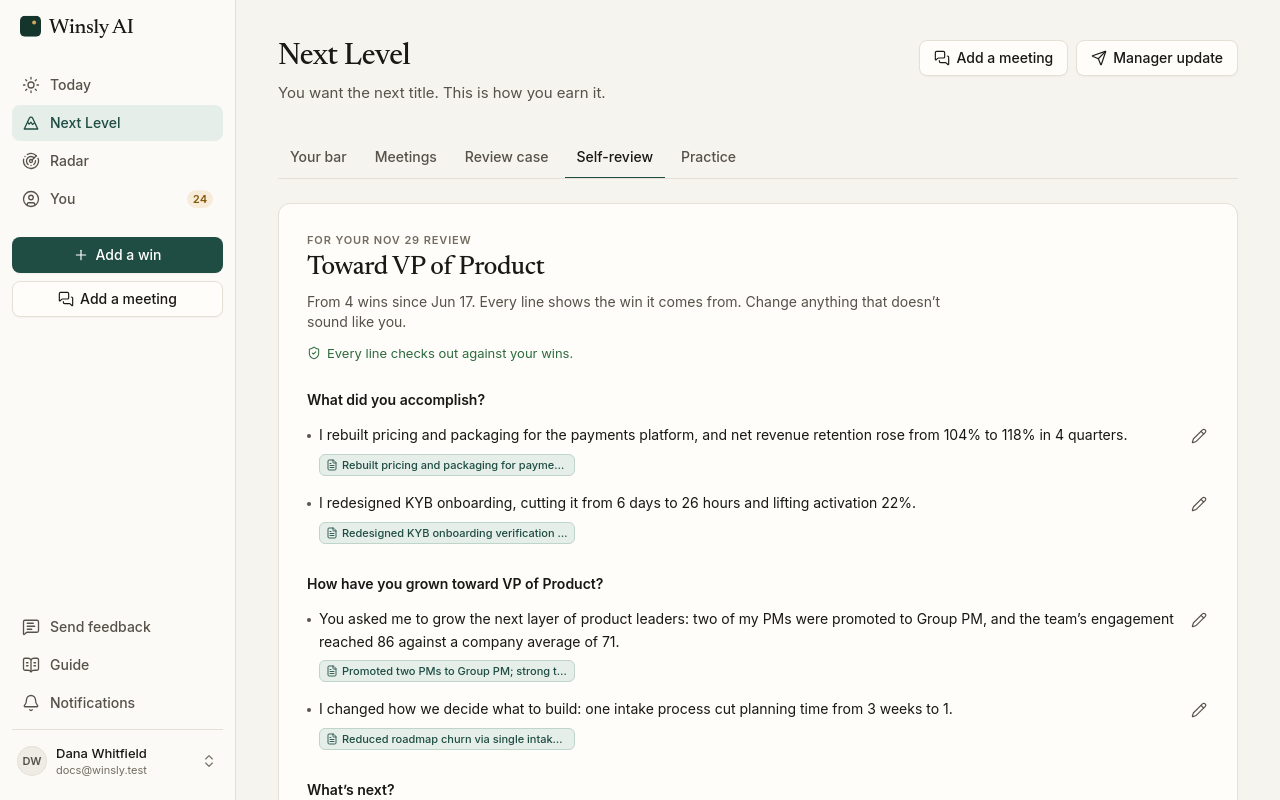
In Winsly
Self-review (on Pro and Advisor) drafts the answers for the period you pick, to Winsly’s 3 questions or your company’s, in your voice and organized around your bar. Every line shows the win it comes from, and it points out any number your wins don’t support. It ends with an ask; you copy it into your form, and Winsly never sends it. Next Level and your review case · Your wins log.