Get promoted · Know the bar
What does it take to get promoted?
It takes showing that you already do the next level’s work. So the first step is knowing exactly what that work is. Criteria stay vague until you ask: get your manager to define them early, in terms of real work, while there’s still time to do it.
Why find out before you’re measured?
Most people find out what the next level required after they’ve missed it. The test is set before you take it, so ask early and in detail, every review cycle. Once you know what the next level requires, it changes which work you go after.
What should you find out from your manager?
Leave the conversation knowing three things:
- The gap. What separates the work you do now from the work at the next level.
- The evidence. What they’d need to see from you over the next six to twelve months to know you’re ready.
- The measure. How they’ll judge it, and what that would look like in a real piece of work.
Raise it in a one-to-one, not at the end of a review when everyone is tired, and take notes. What to say in your 1:1 covers the rest of the agenda.
How do you make vague criteria checkable?
The answers you get first are usually vague: more leadership, more strategic, more ownership, executive presence. Don’t accept them as they are. Ask what you’d have to do, and what your manager would have to see. A criterion is defined when you can name a piece of work that would show it.
| What you hear | What you could show |
|---|---|
| Show more leadership | Run the team’s quarterly planning, start to finish |
| Be more strategic | Bring a recommendation on a decision above your level, with options and trade-offs |
| Executive presence | Present the monthly results to the leadership team and take the questions yourself |
| Own more | Take a process nobody owns, like vendor renewals, and run it end to end |
| Influence across teams | Get two teams to agree on a shared plan and see it through |
The bar is different at each step. Getting promoted to manager, senior or director shows what each one usually asks for.
What if your manager can’t say?
Sometimes the answer is “I’m not sure.” Push gently on why. Is it that the criteria aren’t known yet, or that promotions will be hard this year no matter how you perform? Those are different situations. The first means you help define the bar. The second means you plan for the cycle after, or ask what else is possible.
How do you keep the bar current?
Send a short note after the conversation: here’s what I heard the next level needs, and what would show each part. It confirms you understood, and it gives you a dated record of the bar to measure against.
Revisit it every cycle. The bar moves as you grow: at one level, running a planning cycle is the proof; a level up, the question becomes whether you can change where the business is going.
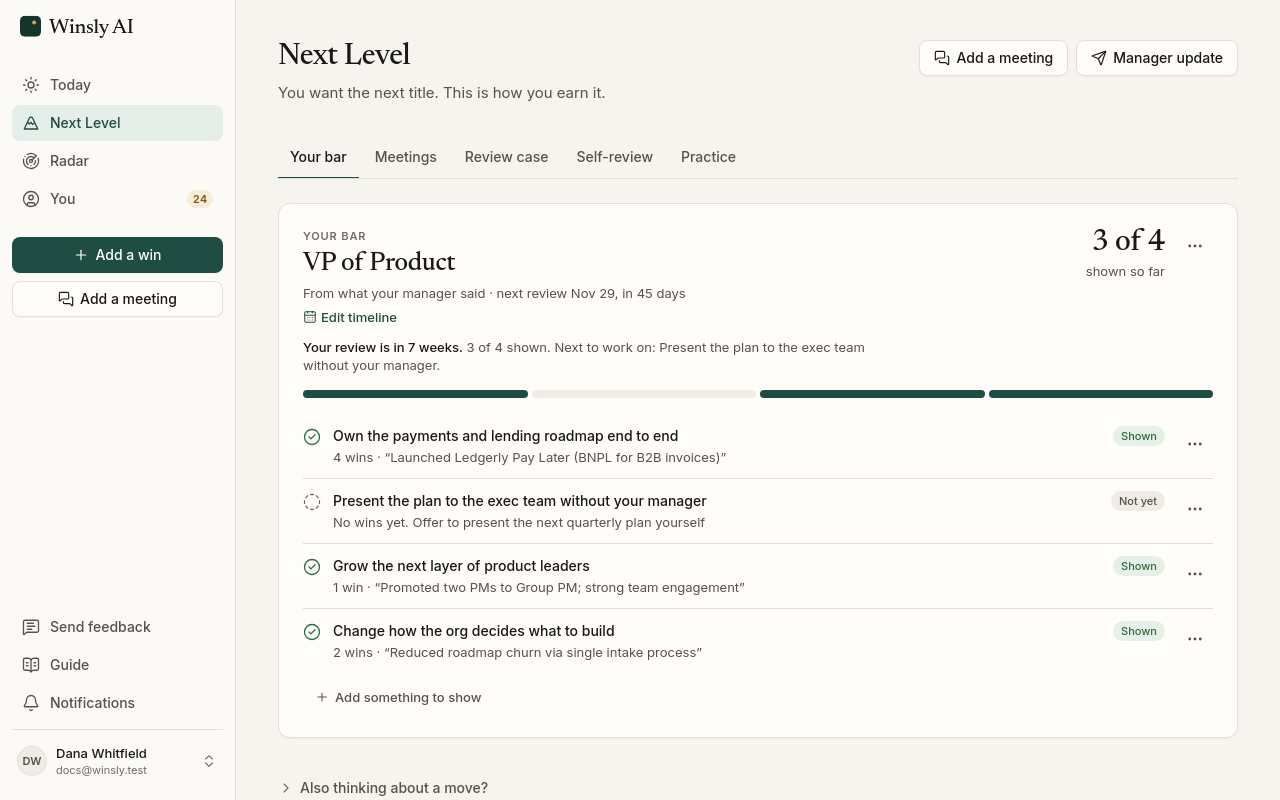
In Winsly
Next Level starts from what your manager said. Paste it in or type it, and Winsly turns it into a clear bar you can check against, then links each win you log to the part it proves. On the Advisor plan, Practice lets you rehearse the conversation first, with the pushback a busy manager would give. Next Level and your review case.