Get promoted · Ask
How to ask for a raise, with proof
Ask before pay decisions are set, soon after a result people saw. Bring what you’ve already delivered, in the business’s terms, with dated proof and a specific number. Make the case from results, not effort. If the answer is no, leave knowing what would make it yes.
When should you ask for a raise?
In many companies, next year’s pay is settled when budgets are set, often months before anyone hears a number. Ask before that, while there’s still room to move; your manager or HR can tell you when.
The best moment is soon after a result people saw: a project landed, a quarter closed well, a problem fixed that leadership cared about. The worst is the middle of a crisis, the week your manager’s budget was cut, or just after something you owned went wrong. Let those pass first.
What should you bring when you ask for a raise?
- What you’ve already delivered, in the business’s terms. Revenue won or kept, cost cut, risk reduced, time saved.
- Dated proof. When each result happened and where someone could check it: a report, a dashboard, a thank-you note from a client. A claim with a date is hard to wave away.
- The number you’re asking for. A specific figure, decided before you walk in. “Whatever you think is fair” hands the decision back with no case attached.
Turning your work into the business’s terms is the step most people skip:
| What you did | In the business’s terms |
|---|---|
| Took over the vendor renewals nobody owned | 3 contracts signed under budget, saving $40,000 a year |
| Rebuilt the month-end reporting pack | Leadership gets the numbers 4 days sooner |
| Fixed the claims intake form | Fewer denied claims, and about 10 hours a week of rework gone |
How do you ask for a raise, step by step?
- Learn the pay calendar. Find out when budgets and pay decisions are set, and plan to ask before then.
- Gather your results. Pick the 3–5 strongest things you’ve delivered since your pay was last set, each dated and in the business’s terms.
- Choose your number. Decide the figure you’ll ask for, and check it against what similar roles pay.
- Ask for the meeting. Tell your manager ahead of time that you’d like to talk about your pay, rather than raising it at the end of a 1:1 about something else.
- Ask, then make the case. Say the number up front, then the results behind it. Then stop talking and listen.
- Agree on the next step. Whatever the answer, leave knowing what happens next and when, and confirm it in a short note.
How do you ask without sounding entitled?
Argue from what you’ve delivered, never from what you promise. A result from last quarter is a fact. More work next year is a hope, and your manager can’t carry a hope to whoever approves pay.
Leave out “I deserve it.” It makes the case about you, when the decision is about the work. The same goes for rising personal costs: they’re real, but the business can’t act on them.
Market data can support the number you ask for, but it doesn’t make the case. It says what the job is worth somewhere, not why you’re worth more here.
In the room, answer first: the number, then the results behind it. Keep it short. Back it with your record: when a point is questioned, point to the dated proof.
What if they say no?
A no is often a “not yet”: the budget is already set, the case isn’t strong enough, or your manager can’t decide alone. Don’t argue it on the spot. Find out instead:
- What would make it yes: which results, shown how.
- Whether the gap is the number, the timing or the case.
- Who else has a say, and whether your manager will take it to them.
- When you’ll revisit it, with a date.
If the next conversation ends the same way, with no clearer reason, it may be time to weigh staying against moving.
Should you ask for a raise or a promotion?
A raise is more pay for the same job. A promotion is the next level, usually with a higher pay range. In many companies, raises are limited by the range for your level, and the bigger changes in pay come with the level itself.
So if you’re already doing much of the job above yours, the cleaner path to more pay is often the level: see how to ask for a promotion. If your role has grown but isn’t yet the next level, a raise is the right ask.
In Winsly
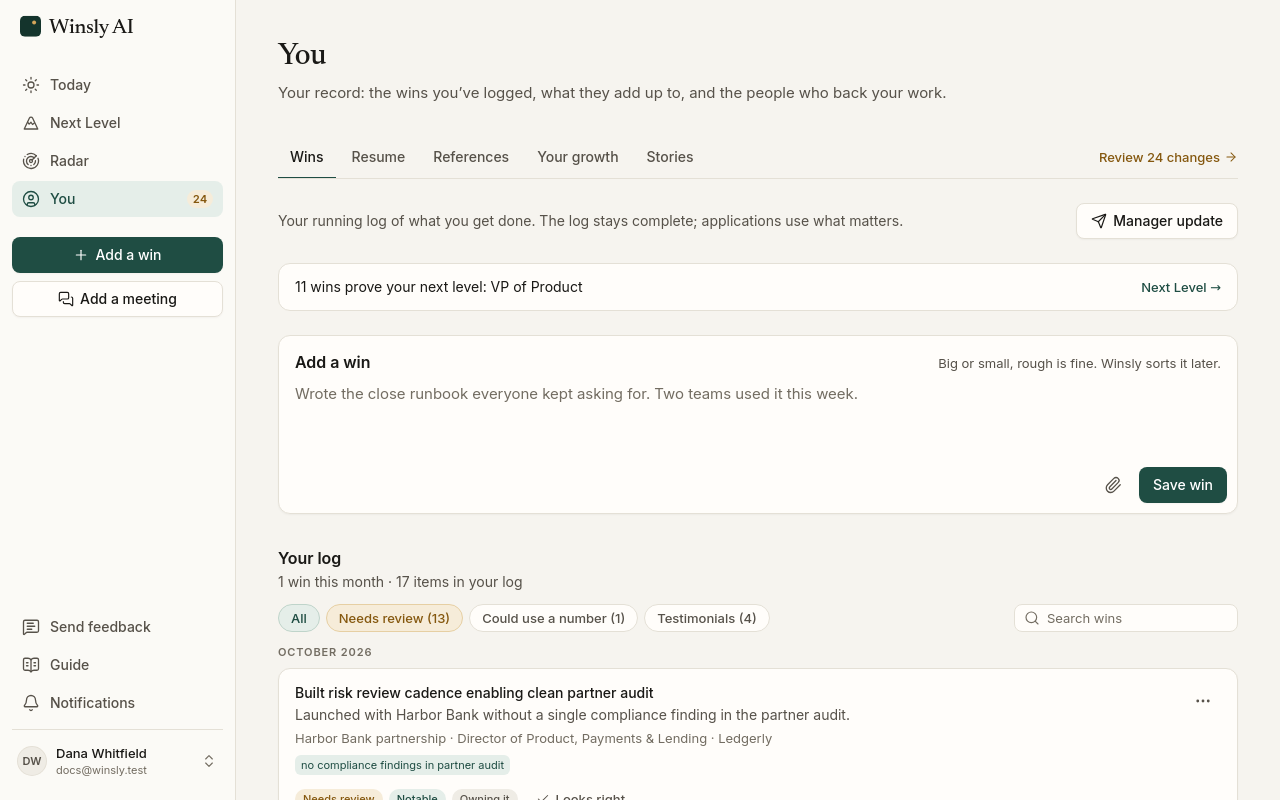
Winsly keeps the dated record a raise case rests on: capture a win in seconds, and it’s there, dated, when you ask. If the level is the better ask, Next Level shows how much of the bar you can show, and your advisor says whether this is the cycle to ask for the level or for the work. Your wins log · Ask your advisor.