Get promoted
How to get promoted
Getting promoted comes down to four moves: find out exactly what the next level requires, show you already do most of it with dated proof, make that work seen by the people who decide, and ask every cycle. Here’s each step, with a guide for every question on the way.
What does it take to get promoted?
A promotion recognizes work you already do at the next level, so the first job is knowing what that work is. Ask your manager what separates your level from the next, what they’d need to see, and how they’ll judge it. Then turn every vague answer, like “more strategic” or “more ownership”, into a piece of work you could point to: what it takes to get promoted.
The bar differs by step: senior, manager and director each ask for different proof. The pace differs too, so it helps to know how long a promotion should take, and to check honestly whether you’re ready.
How do you prove you’re ready?
Keep a running log of what you did, who it affected and when, the day it happens: a brag document, ideally one that starts with the bar. You can’t tell yet which work will matter, and nobody else is keeping track. When review time comes, sort the strongest wins under each part of the bar. That selective version is your promotion case, and it’s what your self-review should say: self-review examples.
How do you get your work seen?
Good work doesn’t speak for itself: your manager is busy with their own. A short, regular note about what moved, with credit to the people who helped, is information they need, not self-promotion: get your work noticed. Use your 1:1s to check where you stand. When the stakes go up, answer first, keep it short and back it with your record: executive presence, made checkable.
When should you ask, and how?
Ask every cycle. Once you can show most of the bar, ask for the level, with the proof in hand. Below that, ask for the work that would close the biggest gap. Either way, leave knowing what’s next: how to ask for a promotion. Asking for more pay works the same way, from what you’ve already delivered, in the business’s terms: how to ask for a raise.
What if it doesn’t happen?
Find out why before you decide anything. Most people are passed over because the bar was never defined, the case wasn’t in front of the people deciding, or the timing was out of their hands. Fix what’s yours to fix and plan the next cycle, or weigh whether the next level is somewhere else: promotion or a new job?
Where does this come from?
These guides draw on one CFO’s playbook. He went from junior analyst to CFO in about ten years by keeping a log of his wins and asking for the next level at every review. About the method.
In Winsly
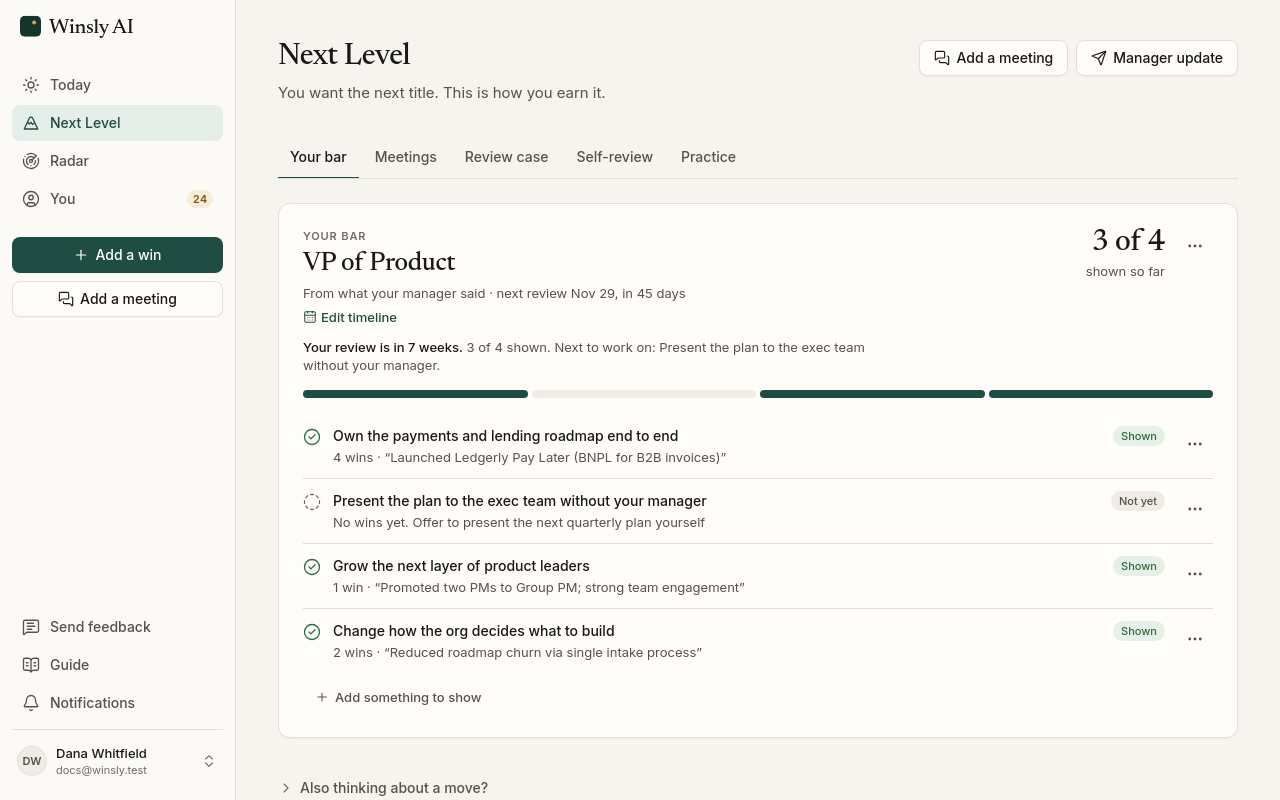
Winsly runs the whole playbook on your record. A win takes seconds to log, and it’s tagged and linked to the part of your bar it proves. Next Level turns what your manager said into a clear bar and shows which wins already prove each part. Your review case and self-review are drafted from those wins, with every line showing its source, and your advisor recommends one next move at a time. How Winsly works.