Get promoted · Know the bar
Manager, senior or director: what each step needs
Each step asks for a different kind of work. Senior means owning hard work end to end without help. Manager means getting results through other people. Director means setting direction across teams and growing leaders. To get promoted to any of them, show that work before you have the title.
| Step | What they need to see | Proof that shows it |
|---|---|---|
| Senior | You own hard work end to end, without help | A hard project you scoped, ran and finished, with the result and the calls you made |
| Manager | You get results through other people | A project you led where others did most of the work; someone you mentored or helped hire; a process others depend on |
| Director | You set direction across teams and grow leaders | A plan more than one team followed; a decision above your level you shaped; a leader you developed |
Not every company runs these in this order, and some have a senior path that never manages anyone. The proof for each step is what matters, whatever your company calls it.
How do you get promoted to senior?
Show that you can own hard work from start to finish without someone stepping in. That means taking a problem that isn’t fully defined, deciding how to approach it, making the calls along the way, and handling what goes wrong.
- A financial analyst builds the new forecast model, defends its assumptions in the planning review, and keeps it current each month.
- An engineer designs a change to a core service, writes the plan others review, ships it and runs it in production.
- An operations specialist takes over a stalled supplier transition and closes it.
What doesn’t show it: more of the same work, or good work done with your manager checking each step. The proof is in what you decided, not just what you delivered.
How do you get promoted to manager?
Show that you get results through other people. The hard part is showing it before you have reports. You can, in ways that don’t need the title:
- Lead a project where others do most of the work: set the plan, split the work, keep it moving and land it.
- Mentor someone, and be able to say what they can do now that they couldn’t before.
- Help hire: write the role, interview, and help the new person get up to speed.
- Run a process others depend on, like weekly planning, the month-end checklist or the on-call rota.
The test is whether the group did better because of you, not whether you did more yourself. A marketing coordinator who ran the launch plan for 4 people, and whose launch went out on time, has a stronger case than one who wrote every piece alone.
How do you get promoted to director?
Show that you set direction across teams and grow leaders. At this level, the question shifts from how well your team delivers to where several teams should be going, and whether the people under you can lead without you.
- Direction across teams. A plan that more than one team followed, and what changed because of it.
- Decisions above your level. A recommendation you brought to leadership, with the options and trade-offs, and what was decided.
- Leaders you grew. Someone you developed who now runs a team or a major piece of work.
These take longer to show, which is part of why promotions slow down at senior levels. Start collecting the proof well before you ask.
What’s the same at every level?
The work changes at each step. The approach doesn’t.
- The bar is defined. Ask your manager what the next level takes, in words that name a piece of work. “More strategic” isn’t a bar; “bring a recommendation on next year’s budget” is. How to get it defined.
- Proof is organized around the next job. Sort your wins under what the next level needs, not by date. A promotion case built that way is one your manager can argue.
- You ask every cycle. For the level when you can show most of the bar, for the work when you can’t. Either way, you leave knowing what the next step needs.
In Winsly
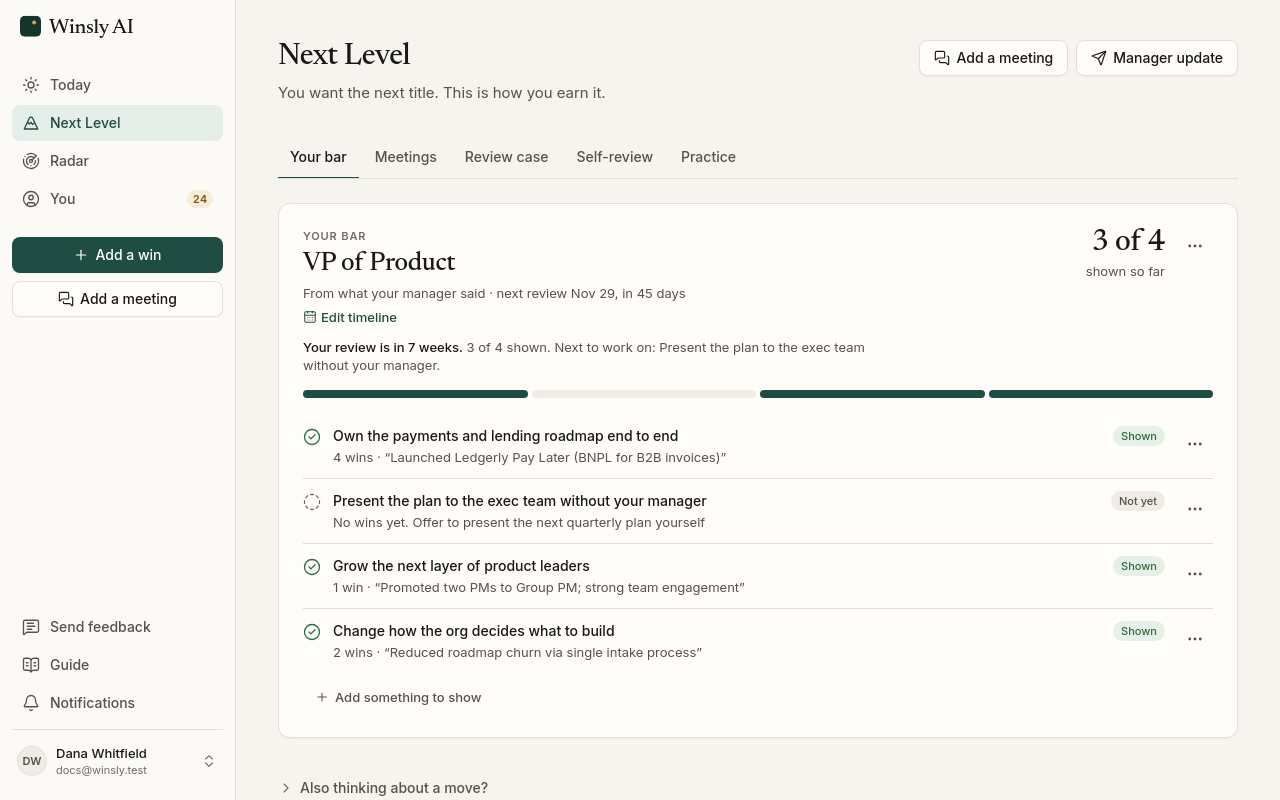
Next Level works the same way at every step, and it’s free on every plan. Paste what your manager said the next level takes, and Winsly turns it into a clear bar, links each win to the part it proves, and shows what isn’t shown yet. Your review case keeps up to 3 wins per part of the bar, strongest first, with every claim cited to a win. Next Level and your review case.