Get promoted · If it doesn’t happen
Passed over for promotion? Why, and what next
Most often, the bar was never defined, nobody argued your case, or the work wasn’t seen. Sometimes it’s budget, or a clearer case. Don’t react in the moment. Find out what was missing and what would make it yes, get the bar written down, and plan the next cycle.
Why do people get passed over for promotion?
Usually for reasons that have little to do with how hard they worked. The common ones:
- The bar was never defined. You were measured against criteria nobody spelled out, or that were too vague to show. Get it defined before the next cycle.
- The case wasn’t in front of the people deciding. Promotions are often settled in a room you’re not in. If nobody walked in with your case, or nobody argued it, it lost by default.
- The work wasn’t seen. Results your manager didn’t hear about, or their boss never saw, count for little at decision time.
- Someone senior doesn’t yet trust the work. Not whether they know you or like you, but whether they’d rely on what you deliver. One doubtful voice can hold a case back.
- Budget, headcount or a reorganization. Sometimes there was no room this cycle, whatever the case. That part is outside your control.
- Another case was simply clearer. Not necessarily better work. Easier to argue.
Each has a different fix, so find out which one it was.
What should you do after you’re passed over?
- Don’t react in the moment. It stings, and that’s normal. Acknowledge the news and ask for time to talk it through in a few days. What you say in the first hour tends to be remembered longer than the decision.
- Ask for a conversation. Within 2 weeks, book time with your manager for this alone. Come curious, not to reopen the decision.
- Find out what was missing. And what would make it yes next time: specific work, not adjectives like “more strategic.”
- Get the bar written down. Turn what you heard into a short list of what the next level takes, and send it back to your manager to confirm.
- Plan the next cycle. For each gap, name the piece of work that would show it and when it’ll happen. Agree it with your manager, and check progress every quarter.
What should you find out?
These are things to learn, not questions to read out. Ask in your own words, and take notes.
- What the decision rested on. Your case, the timing, the budget, or someone else’s case.
- What wasn’t shown. Which parts of the bar, and in whose view.
- Who had doubts. Whether someone senior needs to see more of your work, and what kind.
- What would make it yes. Specific work you could do before the next decision.
- Whether your manager will argue it next time. And what they’d need from you to do it well.
- When the next decision is. So you can plan backward from it.
If the answers stay vague, ask for 1 concrete example of work that would have made the difference. If nobody can give one, that’s an answer too.
Should you stay or leave after being passed over?
One missed cycle isn’t, on its own, a reason to leave. Often the next one goes differently once you know what was missing and your manager knows you’re working on it.
Some answers point the other way: nobody can say what it takes, the bar has moved since last time, or there’s no role above you to move into. If that’s what you hear, it’s worth weighing a promotion against a new job. Decide after the conversation, not before it.
How do you make the next cycle different?
Most of what goes wrong is fixable before the next decision.
- Log as you go. Write down each win when it happens, so the case isn’t rebuilt from memory in the last week. A brag document makes it easy.
- Make the work seen. A short, regular note to your manager about what moved, with credit to who helped. See how to get your work noticed.
- Go after the gaps. Ask for the work that shows what was missing.
- Check in each quarter. Where you stand against the bar, so the next decision holds no surprises.
- Hand your manager the case early. Weeks before the decision, not the night before: something they can carry into the room and argue.
In Winsly
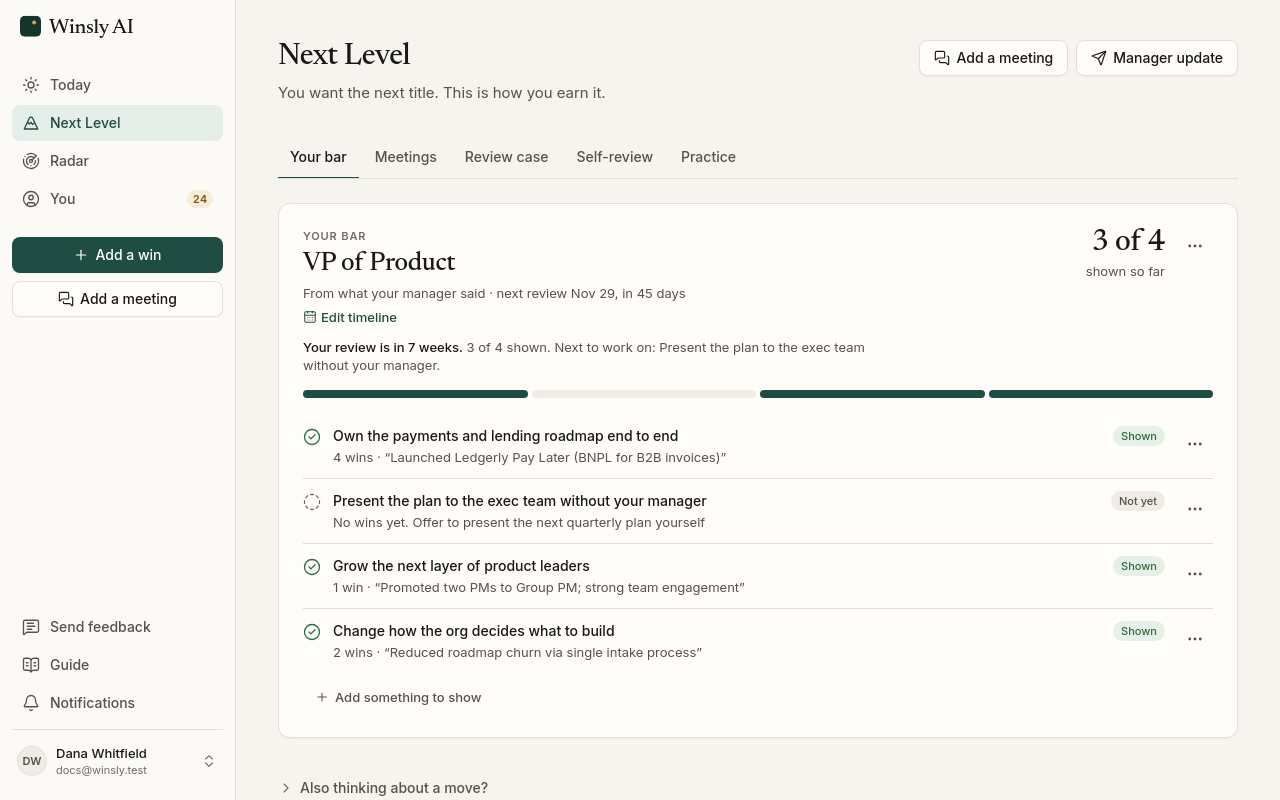
Next Level turns what your manager told you into a clear bar, links each win you log to the part it proves, and shows how much is shown and what isn’t yet. Start next cycle keeps the bar where the last review ended and opens the next cycle, so you begin with the target already defined. Your advisor says whether this is the cycle to ask for the level or for the work. Next Level and your review case · Ask your advisor.