Get promoted · Know the bar
Am I ready for a promotion? How to tell
You’re likely ready when you can show most of what your manager said the next level needs, each part backed by dated work, when you already do parts of the next job, and when the people who’ll weigh in trust your work. Time in the role doesn’t settle it.
What are the signs you’re ready for a promotion?
Each of these is something you can check, not a feeling.
You can show most of the bar, with dated proof
Your manager has said, or can say, what the next level takes. For most of those parts, you can point to a piece of work with a date and a result. Not “I’m strong with stakeholders,” but “ran the budget review with 4 department heads in March, and it closed a week early.” If you can’t name the work, that part isn’t shown yet, however true it feels.
You already do parts of the next job
In many companies, a promotion recognizes work you’re already doing rather than betting on work you might do. Look for the moments you’ve stepped up: you covered while your manager was out, you now run something they used to run, people bring you calls above your role. A marketing specialist who now plans the quarterly campaign calendar is doing part of the manager’s job, and can say so.
The people who’ll weigh in trust your work
A promotion is rarely one person’s decision. Your manager usually has to argue for it, often to people above them or in other teams. Ask whether those people trust your work: not whether they know you or like you, but whether they’d expect something you own to come out right. If one of them has never seen your work up close, that’s a gap as real as a missing skill.
What doesn’t count as being ready?
Some things feel like readiness and aren’t.
- Tenure. Being in the role for 3 years shows you’ve been there 3 years. It says nothing about the next job.
- Effort. Long hours are about you. A promotion case is about the role.
- Being busy. A full calendar can be the current job done at higher volume. More of the same work isn’t the next level’s work.
- A good month. One strong quarter-end is noise. What counts is a pattern that holds over months.
None of these hurt you. They just don’t answer the question your manager will be asked: is this person already doing the job?
How do you know if you’re ready for a promotion, honestly?
The honest answer to “am I ready for a promotion?” comes from laying your proof against the bar, part by part.
- Write down the bar in your manager’s words. If you don’t have it yet, get it defined first.
- Under each part, list only the wins that show that part, with dates and results.
- Mark each part shown, partly shown or not shown.
- Name what isn’t shown, in one plain sentence.
An operations coordinator going for operations manager might end up with this:
| What the next level needs | Proof | Shown? |
|---|---|---|
| Runs scheduling for the whole site | Took over both shifts’ schedules in April; overtime fell from 60 hours a week to 35 | Yes |
| Handles vendor problems without escalating | Reworked late-delivery terms with 2 carriers in June; a third is still with the manager | Partly |
| Trains new staff | No proof yet | No |
Then read it the way your manager would, going into a room where you won’t be. Would they have enough to argue it? A gap named precisely, like “hasn’t trained anyone yet,” is one you can close. A gap like “needs more presence” isn’t defined yet, so ask what would show it.
What if you’re close but not there yet?
Close is useful. It tells you where to spend the next few months. Instead of asking for the level and hearing “not yet,” ask for the piece of work that would show your biggest gap. For the coordinator above, that’s training the next 2 new hires. For someone who hasn’t presented to leadership, it’s presenting next quarter’s results.
Then keep the proof as it happens, in a running log of your wins, so the next conversation starts from the record. When you do ask, bring that proof with you.
In Winsly
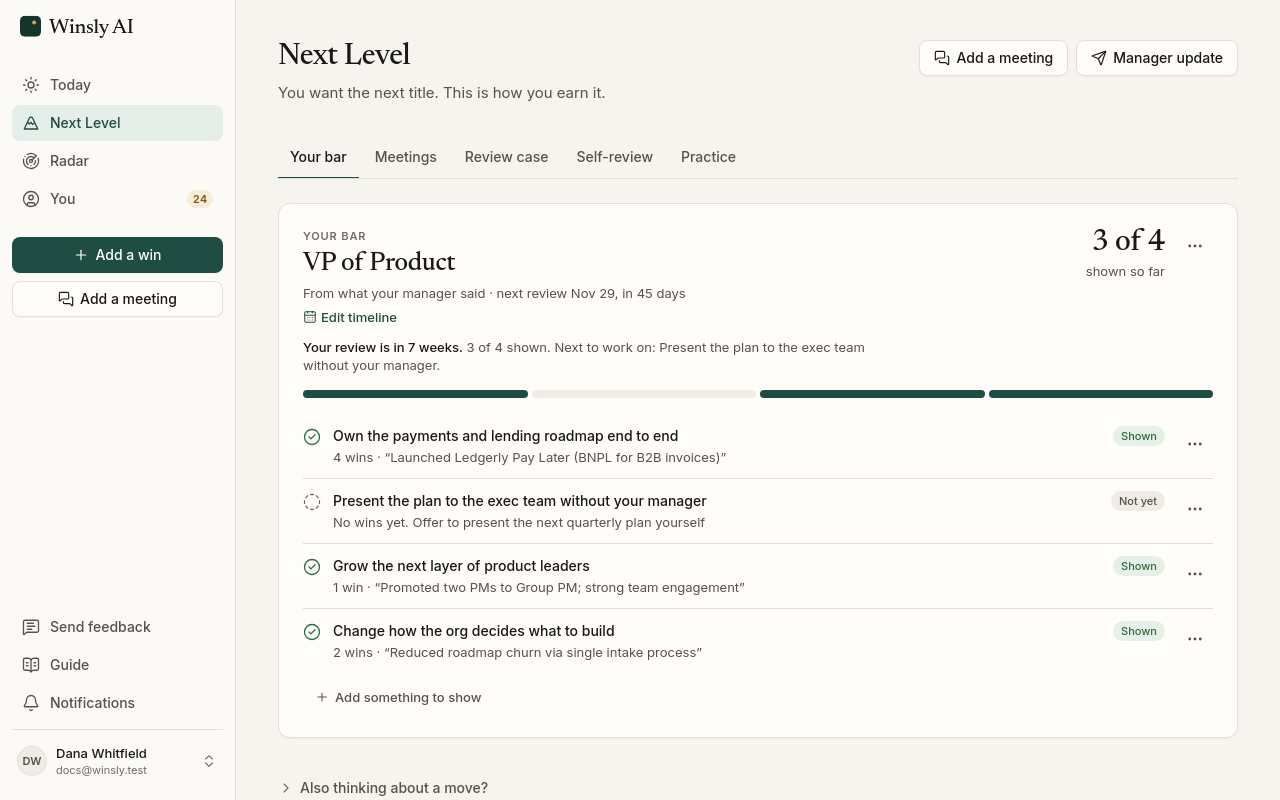
Next Level turns what your manager said into a clear bar, links each win you log to the part it proves, and shows how much of the bar is shown and what isn’t yet. Your advisor says whether this is the cycle to ask for the level or for the work. Next Level and your review case · Ask your advisor.