Why Winsly · Promotion tools
Your company’s review tool, and your own record
Choose Winsly for the record that’s yours, and an advisor who knows it. It keeps the wins that never reached your company’s systems, the bar in your manager’s own words and wins colleagues verify. It goes with you when you change managers or jobs. Use your company’s tool for the formal review, where it’s the official system. Most people should use both.
At a glance
| Winsly | Lattice, 15Five or Culture Amp | |
|---|---|---|
| Whose record it is | Yours, across managers and jobs | Your employer’s |
| What’s in it | The wins you choose to keep, including work that never reached the company’s systems | Partly: updates, goals and 1:1s in the company’s system, plus connected tools such as Jira and Slack |
| The bar for your next position | Your manager’s own words, from what they said or a 1:1 you share with your advisor | Your employer’s framework (Lattice Grow) |
| Wins verified by colleagues | Someone who saw the work confirms or corrects a specific win, and it carries their name | Peer feedback in reviews |
| Private from your employer | Yes: nothing reaches your employer unless you take it there | No: your employer runs it |
| If you decide to move | The same record writes a resume tailored to the job | Not offered |
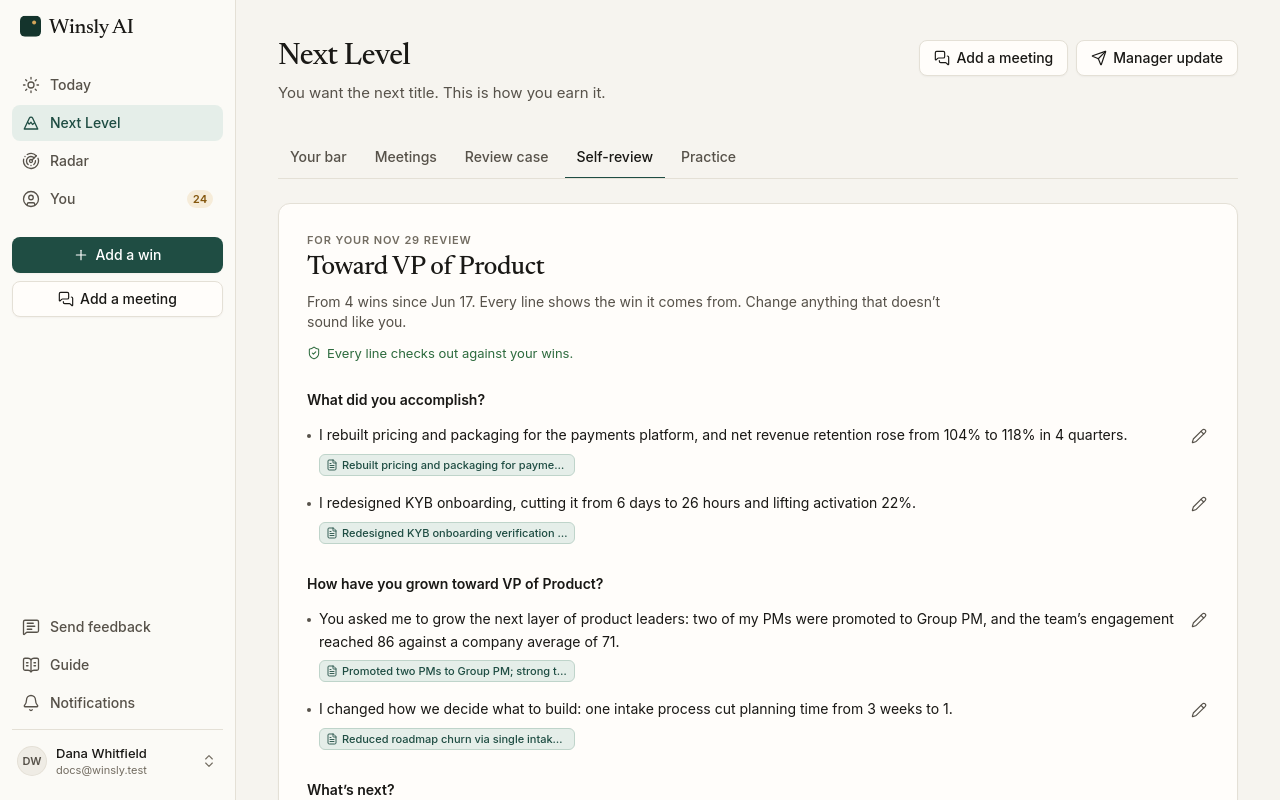
| Self-review drafts | From your review case, organized around your bar, every line showing its win | Lattice: yes, citing sources (July 2026). 15Five: yes, since September 2026, first as a beta. Culture Amp: coaches you as you write, without drafting |
Both do: work with Claude and ChatGPT. Lattice and 15Five connect to them for their customers, and at 15Five an admin turns it on (Lattice, 15Five).
Where Winsly is different
- An advisor who knows your whole record. Your company’s tool drafts from what’s in its system. Winsly’s advisor has read every win you kept, your bar and your case. Ask what your self-review should lead with, or whether this is the cycle to ask. Then practice the conversation out loud.
- A record that’s yours. Your company’s tool keeps your employer’s record, and it stays behind when you leave. Winsly’s goes with you, across managers and jobs, and your resume stays current from it.
- The wins that never reached the system. Praise in a DM, a fix nobody filed, work that never made a 1:1 or a goal. Add them in a line, from a screenshot, from a 1:1 you share with your advisor, or from Claude or ChatGPT.
- The bar in your manager’s words. A company framework says what a level means across the company. Winsly turns what your manager said into your bar, and shows which wins prove each part.
- Wins colleagues stand behind. Ask someone who saw the work to confirm or correct a win by email, and it then carries their name in your case. Ask for references the same way.
- Private by default. Nothing reaches your employer unless you take it there, and your employer’s and customers’ names stay out of anything you share.
Where your company’s review tool fits
- You’re writing the formal review. It’s the official system: free to you, read by your manager, and tied to how ratings and pay are decided. It also holds peer feedback and your 1:1 notes. In September 2026, Lattice said its drafts are coming to promotion reviews (Lattice).
- Your work already lives in the company’s systems. Lattice’s drafts cite their sources, show how confident they are, and flag thin evidence instead of inventing it (Lattice, July 15, 2026). Since November 2026, its weekly updates draft themselves, and its review drafts pull in work, from connected tools such as Jira, GitHub, Asana, Slack, Linear and Notion (Lattice). 15Five drafts from check-ins, objectives, 1:1s and connected Slack, Jira, Asana and Google Drive, since September 2026, first as a beta, once an admin turns it on (15Five). Culture Amp’s AI Coach helps you put your impact into words as you write (Culture Amp, June 2026).
Who should choose which
- Winsly for your own record and an advisor who knows it: the wins that never reached the company’s systems, the bar in your manager’s words, and a case that goes with you.
- Your company’s tool for the formal review, when your company runs one.
- Both, for most people: your company’s tool for the formal review, and Winsly for the record that’s yours. Take your review case into the company’s self-review, so its drafts have the evidence they need.
Prices, checked November 21, 2026
| Product | Price | Source |
|---|---|---|
| Winsly | $20 a month or $200 a year, with 600 credits a month; 7 days free | Pricing |
| Lattice | Performance $10 per seat a month, billed yearly, $4,000 a year minimum; Grow +$4 per seat. Paid by your employer. | lattice.com/pricing |
| 15Five | Perform $11 per person a month, billed yearly, with AI-assisted reviews; Total Platform $16. Paid by your employer. | 15five.com/pricing |
| Culture Amp | Quote only: depends on the number of employees, the products and the service tier, billed yearly. Paid by your employer. | cultureamp.com/pricing |
Prices and features change. See something out of date? Write to support@winsly.ai. Product names are trademarks of their owners.
Questions
How do I write a strong self-review?
Start from what your manager said the next position needs, and answer each part with specific wins and their results. Leave routine work out.
My company’s tool drafts my self-review. Do I still need my own record?
It drafts from what’s in your company’s systems and the tools connected to them. Wins that never reached a 1:1, an update or a connected tool aren’t there, and the record stays with your employer if you leave. Your own log fills both gaps.
What happens to my review history if I leave?
That depends on your employer and the tool, so ask your HR team. A record you keep yourself goes with you.
Is it OK to keep work notes outside company systems?
Keep notes about your own work, and leave out confidential documents. Winsly keeps your employer’s and customers’ names out of anything you share.